Best Lawn Spreaders and Seeders Compared

The best lawn spreader or seeder is the one that matches your yard size, material, terrain, and tolerance for calibration and cleanup. Broadcast spreaders cover open areas quickly, drop spreaders favor placement control, handheld models suit small jobs, and tow-behind units serve larger properties. Choose…
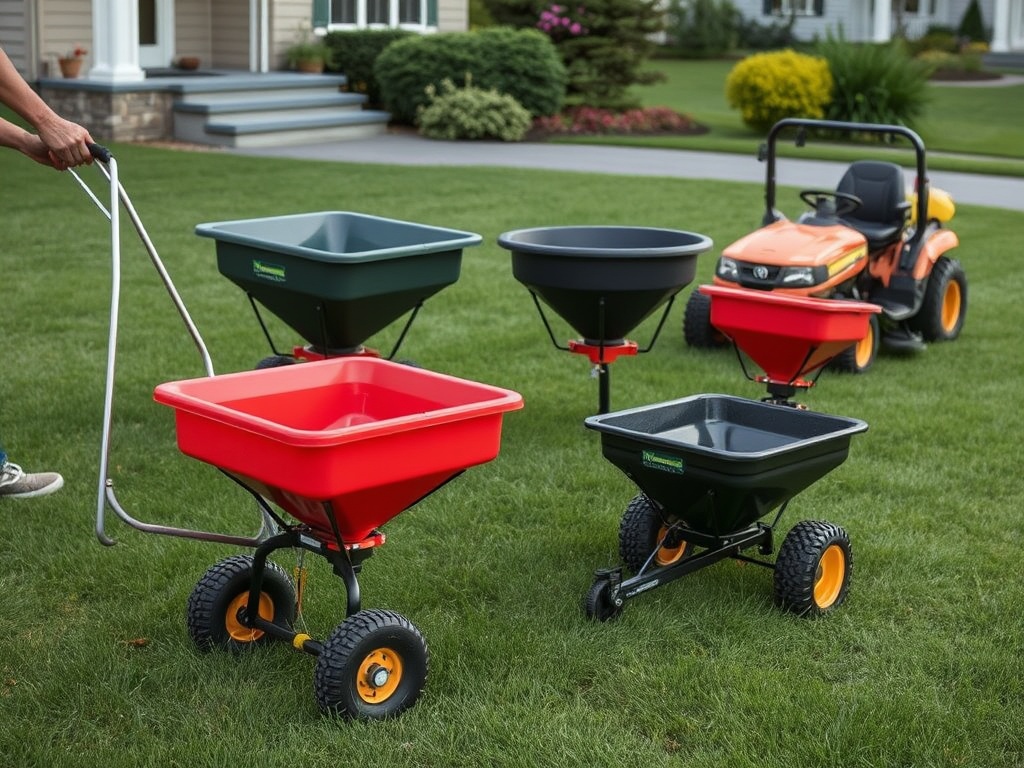
The best lawn spreader or seeder is the one that matches your yard size, material, terrain, and tolerance for calibration and cleanup. Broadcast spreaders cover open areas quickly, drop spreaders favor placement control, handheld models suit small jobs, and tow-behind units serve larger properties.
- Choose the spreader type before comparing brands or accessories.
- Broadcast models favor speed; drop models favor edge control.
- Handheld units make sense for small patches and occasional use.
- Tow-behind spreaders can reduce walking on large lawns but need storage and a compatible tractor or mower.
- Calibration, corrosion resistance, tire quality, hopper size, and parts support matter more than flashy extras.
Match the Machine to the Job
A spreader meters seed, fertilizer, lime, or another granular material onto a lawn. The main designs differ in how they release that material. There is no universally superior format because a tight urban lawn with beds on every side presents a different problem from a broad, open acre.
Before shopping, write down your approximate lawn area, typical material, slopes, gate widths, storage space, and whether you already own a tow-capable lawn tractor. If you seed only a few bare patches each year, a large wheeled unit may add cost and storage without improving the work.
Penn State Extension emphasizes calibration because application rate depends on both spreader settings and the operator’s pace or pattern (fertilizer spreader calibration guidance). That makes easy adjustment and repeatable operation important selection criteria, not minor conveniences.
Spreader Types at a Glance
| Type | Best fit | Main advantage | Main tradeoff |
|---|---|---|---|
| Broadcast or rotary | Medium to large open lawns | Fast, wide coverage | Granules can reach beds or pavement without careful edging |
| Drop | Small to medium lawns with defined edges | Precise delivery between the wheels | Narrower passes require more walking and accurate overlap |
| Handheld | Small lawns, touch-ups, patch seeding | Low cost and easy storage | Output depends heavily on walking and cranking consistency |
| Tow-behind | Large properties | High capacity and less pushing | Requires towing equipment, turning room, and more storage |
This comparison describes general design tendencies. Actual performance depends on the individual product, material particle size, condition, settings, and user technique.
Broadcast Spreaders: Best for Open Coverage
A broadcast spreader uses a rotating plate to throw granules outward. That wider swath can make lawn feeding or overseeding faster on open ground. It is particularly useful when repeated narrow passes would be inefficient.
The tradeoff is control near flower beds, driveways, ponds, and sidewalks. Many models offer an edge guard, but the operator still needs to understand the throw pattern. Sweep or blow granules off hard surfaces according to label instructions so fertilizer and pesticide products do not wash into storm drains.
Look for a stable frame, smooth gate action, durable wheels, an accessible rate control, and a hopper that can be emptied and cleaned without awkward disassembly. A very large hopper is not automatically better; loaded weight can make a push unit harder to handle on slopes or soft ground.
Drop Spreaders: Best for Defined Boundaries
A drop spreader releases material through openings across the width of the hopper. The material falls largely between the wheels, which can make it easier to work near beds and hardscape. The defined application band also helps users visualize where material has been placed.
The narrower pattern means more passes. Gaps can leave untreated stripes, while excessive overlap can double the application rate. Careful wheel tracking and calibration matter. Drop models can be a strong choice for rectangular lawns, narrow strips, or properties where keeping material away from adjacent planting beds is a priority.
Handheld Seeders and Spreaders: Best for Small Jobs
Handheld units range from simple shaker containers to crank-driven broadcast devices. Their strengths are low storage demand, quick setup, and suitability for patch repair or small yards. They can also be useful when a wheeled spreader cannot comfortably reach a narrow area.
The limitation is consistency. Walking speed, hand height, crank rhythm, and fill level can alter distribution. For a whole medium-sized lawn, that variability and operator fatigue may outweigh the lower purchase price. For a few hundred square feet or occasional spot work, a handheld tool may be entirely adequate.
If you are tempted to buy several inexpensive specialty tools instead of one reliable core tool, review the biggest garden tool buying mistakes homeowners make before expanding the shed.
Tow-Behind Models: Best for Large Properties
Tow-behind spreaders attach to a compatible mower, tractor, or utility vehicle. Their larger capacity and reduced pushing effort can make sense on large lawns. They are less attractive where gates are narrow, turns are tight, slopes are uncomfortable to drive, or storage is limited.
Check the towing vehicle’s instructions and the spreader’s hitch requirements rather than assuming compatibility. Also consider how easily the flow can be started and stopped from the operator position. A unit that continues dropping material while turning or stopping can create overapplication.
Features Worth Comparing Before Price
Calibration and control
Clear settings, a predictable shutoff, and a gate that returns to the same position are valuable. No printed dial number can replace calibration for your specific product and walking pattern. If the label specifies an application rate, follow that label and verify the spreader output rather than relying on a generic chart.
Wheels and frame
Hopper and cleanout
Capacity should match realistic batch size. A hopper that is easy to rinse or brush out can reduce residue buildup, but cleaning must follow the material label and local disposal rules. Never wash pesticide or fertilizer residues into a storm drain.
Parts and storage
Replacement cables, impellers, gates, tires, and hardware can extend useful life. Measure storage space before buying a wide or tow-behind unit. Folding handles can help, but inspect how securely the mechanism locks during use.
Seeders Versus Spreaders: Do You Need a Dedicated Tool?
Many lawn spreaders can distribute grass seed, but not every seed flows the same way and not every product provides reliable settings for every material. Fine, light, irregular, or coated seed may behave differently from dense fertilizer granules. A dedicated seeder can be useful if its metering system handles your chosen seed more predictably.
For lawn establishment, seed-to-soil contact and site preparation matter as much as distribution. Penn State’s lawn establishment guidance stresses preparing the seedbed and following sound seeding practices rather than treating spreading as the entire job (Penn State lawn establishment).
If a landscape renovation is driving the purchase, how to refresh an outdated landscape without starting over can help determine whether reseeding is actually the next priority.
A Shortlist by Yard and Budget Logic
For a small yard or occasional patching, start with a well-made handheld model. For a compact lawn with beds and hard edges, consider a drop spreader. For a medium or large open lawn, a push broadcast model often offers the best balance of coverage and storage. For very large properties with suitable towing equipment, a tow-behind spreader may justify its capacity.
Choose the Spreader You Can Use Consistently
The right spreader makes correct application easier, but it cannot correct an unsuitable product rate, poor seedbed preparation, or careless overlap. Select a format that fits the property, learn its pattern, calibrate it, and maintain it after use.
A modest tool that you understand is often more useful than a high-capacity model that is awkward to store or control. Base the purchase on recurring lawn tasks rather than the most impressive specification on the box.
Informational note: Home and garden information is educational only and is not a substitute for professional horticultural, pest-control, structural, electrical, or legal advice. Follow product labels, equipment manuals, and local environmental requirements.

Dr. Emily Watson
Location: Princeton, New Jersey Dr. Emily Watson is a quantum computing researcher and physicist who translates complex scientific concepts into accessible insights for business and technology leaders. Based in Princeton, home to leading research institutions, Emily holds a PhD in Physics from Princeton University and has published extensively on quantum algorithms and their applications. Her writing at Nano Write covers the science and business of quantum computing, from the physics of qubits to real-world use cases in cryptography, drug discovery, and optimization. Emily believes that quantum computing will be the next major technological revolution and she is committed to preparing leaders for that transformation. Outside of her research, Emily speaks at technology summits and advises startups at the intersection of physics and commerce.
More from Dr. Emily