How to Harvest Herbs for More Regrowth

Herbs usually keep producing longer when you harvest them in a way that leaves enough healthy growth behind. The key is to make clean cuts at the right point on the stem, avoid taking too much at once, and give the plant time to recover…
Herbs usually keep producing longer when you harvest them in a way that leaves enough healthy growth behind. The key is to make clean cuts at the right point on the stem, avoid taking too much at once, and give the plant time to recover between harvests.
TL;DR
- Harvest healthy herbs after surface moisture has dried and before heat stress sets in.
- For branching herbs, cut just above a leaf node so side shoots can develop.
- Take modest amounts from young or slow-growing plants rather than stripping them heavily.
- Remove flowers on leafy herbs when your goal is continued leaf production, unless you want blooms or seed.
- Adjust the method to the herb: basil, mint, parsley, chives, rosemary, and thyme do not all regrow in the same way.
Start With the Way the Herb Grows
A productive harvest begins with plant structure. Many leafy herbs form new shoots from nodes, the points where leaves and side stems meet the main stem. Cutting just above a healthy node can leave buds below the cut available to grow. The University of Minnesota Extension specifically recommends cutting herbs in the mint family above a leaf set and notes that pinching growing tips can encourage bushier growth (UMN Extension herb guidance).
That principle works especially well for basil, mint, oregano, and similar branching herbs. It is less useful for plants harvested leaf by leaf, such as parsley, or clump-forming herbs such as chives. Before cutting, identify whether you are removing a stem tip, individual outer leaves, or a portion of a clump.
If you are still building a kitchen-garden routine, pair harvesting with basic soil and moisture care. A plant that is constantly wilted, nutrient-stressed, or root-bound has less capacity to replace what you remove. For a low-waste way to recycle kitchen scraps into a soil amendment, see how to start vermicomposting indoors.
Tools and Timing for a Clean Harvest
You do not need specialized equipment for most herbs. Clean scissors, snips, or pruners are enough for tender to moderately woody stems. Fingers can work for soft tips, but a tool gives more control when stems are fibrous or crowded.
Use a clean cutting edge and avoid crushing stems. If a plant shows signs of disease, sanitize tools before moving to another plant to reduce the chance of transferring contaminated sap or debris. The exact cleaning method should follow the tool manufacturer’s instructions and any relevant plant-disease guidance.
Harvesting in the cooler part of the day is often more comfortable for both gardener and plant, particularly during hot weather. Avoid cutting foliage that is soaking wet if doing so would spread disease or leave you handling a slippery plant. For culinary use, select clean, healthy leaves and discard damaged or diseased material.
Step by Step: Harvest for Continued Growth
1. Inspect the plant before you cut
Look for active growth, healthy color, and enough foliage to support recovery. A newly transplanted herb, a plant recovering from drought, or a small seedling should be harvested lightly. If most of the plant is yellowing, wilted, or pest-damaged, solve the underlying problem before taking a large harvest.
2. Find a strong node on branching herbs
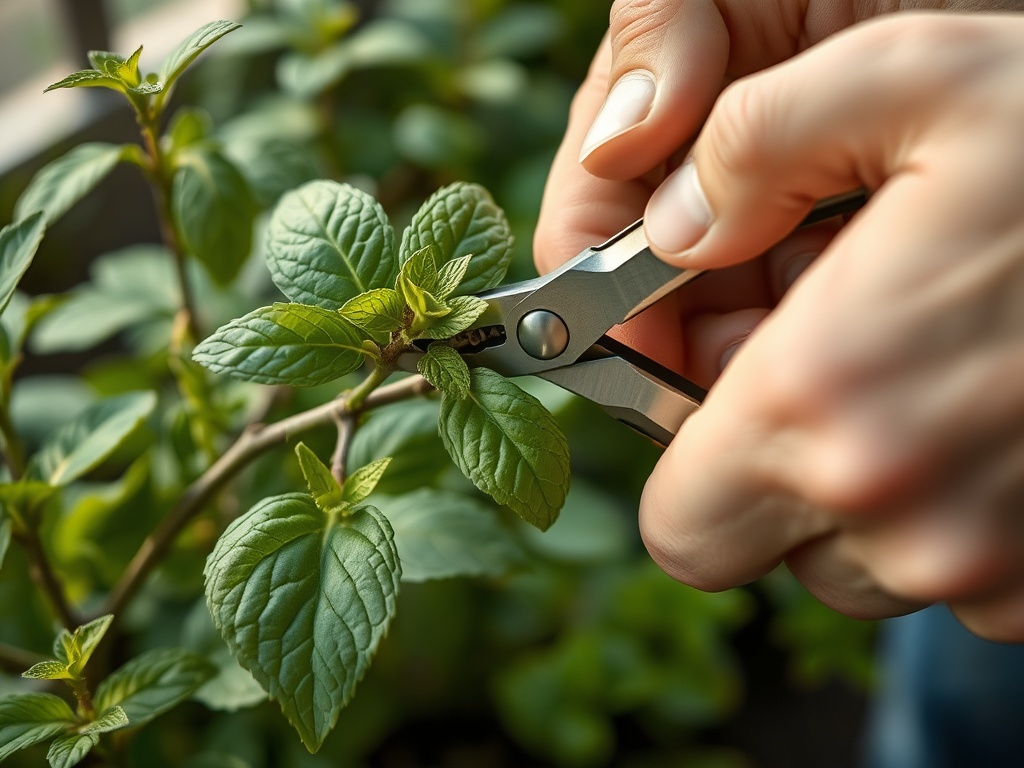
On basil, mint, and similar plants, trace a harvestable stem downward until you see a pair or cluster of healthy leaves. Make the cut slightly above that point. Leaving the node intact gives the remaining stem a place from which side growth can emerge.
Do not leave a long bare stub above the node. It contributes little and may die back. At the same time, do not cut so close that you injure the buds or leaf bases you want to keep.
3. Harvest outer leaves from rosette or crown-forming herbs
Parsley is commonly harvested by removing the larger outer stalks near the base while leaving the younger center growth. UMN Extension advises harvesting parsley leaves as needed and notes that established plants can be cut for continued use (parsley growing guide). Cilantro is similar in that selective leaf harvests can preserve the center for a time, although heat and day length can push it toward flowering quickly.
4. Cut clump-forming herbs above the crown
For chives, cut leaves rather than pulling whole plants from the soil. Leave enough green tissue and the growing crown intact so the clump can send up fresh leaves. If the clump is weak or sparse, take less and allow a longer recovery period.
5. Be conservative with woody herbs
Rosemary, thyme, sage, and lavender can become woody with age. Harvest the flexible green growth first and avoid severe cuts into old bare wood unless reliable species-specific pruning guidance supports it. Some woody herbs resprout poorly from leafless stems, especially when stressed or growing in unsuitable conditions.
How Much Can You Safely Take?
There is no single percentage that fits every herb, season, climate, container, and plant age. A vigorous basil plant in warm growing weather can usually tolerate more frequent tip harvests than a young rosemary plant growing slowly in a cool window. Treat fixed harvest fractions as rough rules of thumb rather than guarantees.
A practical approach is to harvest modestly, then watch the plant. If it responds with new shoots and maintains good leaf color, the interval is probably reasonable. If regrowth slows, stems become sparse, or the plant wilts repeatedly, reduce harvest intensity and review light, water, root space, and nutrition.
Water management matters because repeated drought followed by heavy watering can stress container herbs. If you are unsure how to judge irrigation needs, the beginner FAQ on lawn and garden irrigation explains soil checks, scheduling, and delivery methods that also help frame sensible watering decisions for garden beds.
Regrowth Problems and What They Usually Mean
Long stems with leaves only at the top
This often happens when gardeners repeatedly pick individual top leaves instead of cutting a stem back to a node. On a branching herb, switch to selective stem-tip harvests that leave healthy nodes lower down. Insufficient light can also contribute to stretched growth, so do not assume harvesting is the only cause.
A plant that stops replacing leaves
Season, temperature, root crowding, flowering, pests, low light, and nutrition can all slow growth. In outdoor beds, chewing damage may also reduce the foliage available for recovery. If slime trails or irregular holes are part of the picture, use the nonchemical-first methods in how to manage slugs and snails before assuming the herb simply needs fertilizer.
Aftercare That Supports the Next Harvest
For perennial herbs, harvesting should also become lighter as growth slows late in the season or when cold weather approaches. Regional climate changes the timing, so use local extension guidance for winter hardiness and pruning schedules rather than applying one calendar date everywhere.
Keep the Plant Productive Through the Season
The best harvest is not the biggest single cutting. It is the one that gives you useful leaves while preserving enough healthy structure for the plant to keep growing. Learn where each herb produces new shoots, cut cleanly, and let the plant’s response determine your next harvest interval.
Use these techniques as a starting point, then adjust for species, climate, plant age, and growing conditions. A short weekly inspection can tell you more than a rigid harvest schedule because it shows whether the plant is actively replacing what you remove.
Informational note: Home and garden information is educational only and is not a substitute for professional horticultural, pest-control, structural, electrical, or legal advice. Follow local guidance and product labels where applicable.

Dr. Emily Watson
Location: Princeton, New Jersey Dr. Emily Watson is a quantum computing researcher and physicist who translates complex scientific concepts into accessible insights for business and technology leaders. Based in Princeton, home to leading research institutions, Emily holds a PhD in Physics from Princeton University and has published extensively on quantum algorithms and their applications. Her writing at Nano Write covers the science and business of quantum computing, from the physics of qubits to real-world use cases in cryptography, drug discovery, and optimization. Emily believes that quantum computing will be the next major technological revolution and she is committed to preparing leaders for that transformation. Outside of her research, Emily speaks at technology summits and advises startups at the intersection of physics and commerce.
More from Dr. Emily