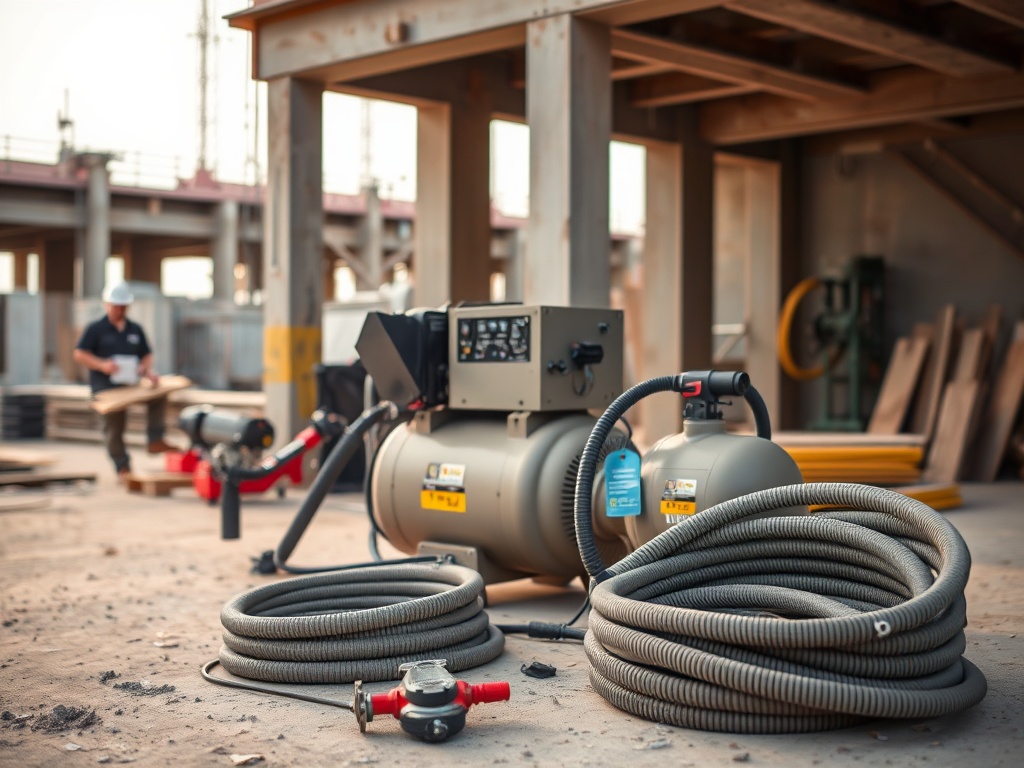
What to look for in a jobsite air compressor

A good jobsite air compressor should match the tools, duty cycle, power source, portability needs, air receiver requirements, hose layout, maintenance access, noise constraints, and safety practices of the work being performed. This article focuses on how to give field teams a buying and selection…
A good jobsite air compressor should match the tools, duty cycle, power source, portability needs, air receiver requirements, hose layout, maintenance access, noise constraints, and safety practices of the work being performed. This article focuses on how to give field teams a buying and selection guide focused on practical jobsite fit and safety.
TL;DR: A good jobsite air compressor should match the tools, duty cycle, power source, portability needs, air receiver requirements, hose layout, maintenance access, noise constraints, and safety practices of the work being performed.
Begin with the tools, not the compressor
The right compressor starts with the tools it must support. Nailers, chipping hammers, spray equipment, sanders, grinders, and pneumatic controls can have very different air demand. Compare required pressure and airflow for each tool, then consider how many tools will run at the same time. A compressor that looks adequate for one tool may fall short when two crews connect at once or when the duty cycle is heavy.
Understand capacity in practical terms
Capacity is usually discussed through pressure, airflow, tank size, and duty cycle. Pressure helps the tool operate within its intended range. Airflow determines whether the tool can keep working under load. Receiver size affects how much stored air is available between compressor cycles. Duty cycle matters because some units are not designed to run continuously in tough jobsite conditions. These details should come from the manufacturer’s documentation and the project’s actual use case, not guesswork.
Check safety and regulatory basics
Compressed air equipment can create hazards through pressure, hoses, fittings, noise, stored energy, and improper use for cleaning. OSHA’s air receiver regulation addresses requirements for air receivers in general industry, and construction teams should also follow applicable safety rules, manufacturer instructions, and site-specific plans. Safety checks should include pressure relief devices, gauges, drain valves, guarding, hose condition, whip checks where appropriate, and training on safe use. For a connected article on the same site, see The pros and cons of self-perform work for specialty contractors.
Match the unit to site logistics
A compressor that performs well in a shop may be wrong for a tight jobsite. Consider weight, wheels, lifting points, fuel or power source, extension cord limits, ventilation, exhaust, noise, weather exposure, theft risk, maintenance access, and hose routing. Indoor work may require special attention to exhaust and air quality. Multi-floor work may favor smaller portable units or planned distribution rather than long tangled hose runs.
Plan maintenance before purchase
Maintenance needs include draining condensation, checking oil where applicable, replacing filters, inspecting belts, testing safety devices, and monitoring hoses and fittings. A unit that is hard to service will often be neglected. Teams should assign ownership for daily checks and record issues before a failure interrupts work. OSHA incident-investigation resources reinforce the value of learning from near misses, which applies when hoses fail, fittings whip, or pressure controls behave unexpectedly.
Field comparison points to review
| Factor | What to check | Why it matters |
|---|---|---|
| Scope clarity | Confirm what is included, excluded, and dependent on others. | Reduces change disputes and prevents field assumptions. |
| Field conditions | Check access, phasing, safety, weather, occupancy, and constraints. | The same scope can perform very differently under different conditions. |
| Documentation | Track decisions, inspections, versions, photos, and closeout evidence. | Creates accountability and protects future maintenance teams. |
Air quality from the compressor may matter
Some tools and processes need clean, dry air. Moisture, oil carryover, or contaminants can affect finishes, equipment, or product quality. For general pneumatic tools, basic filtration and draining may be enough, but finishing work, controls, or specialty applications may need dryers, filters, or oil-free equipment. The buying decision should consider the quality of air required, not only pressure and volume. For broader professional context, OSHA air receiver regulation can help teams verify terminology and expectations.
Hoses and fittings are part of the system
A compressor cannot perform safely if the distribution setup is poor. Long hose runs, damaged fittings, undersized hoses, missing restraints, and trip hazards can create delays and injuries. Plan hose diameter, routing, protection at crossings, storage, and inspection. The safest setup is usually the one that makes the correct behavior easy for the crew on a busy day.
Documentation that protects the decision
The strongest teams write down the assumption behind the decision before work begins. That record does not need to be complicated. It should identify the scope, the responsible person, the major constraints, the standard for acceptance, and the evidence that will prove the work was completed properly. This habit helps new people understand the decision later, reduces arguments about what was intended, and gives maintenance or operations staff a cleaner handoff after the project is complete.
How to adapt the advice to different projects
Small projects may only need a brief checklist and a shared folder, while complex projects may need formal logs, meetings, signoffs, and owner approval steps. The principle is the same: match the management effort to the risk. A low-risk maintenance task should not be buried in paperwork, but a code-sensitive, safety-sensitive, or hard-to-reverse decision deserves more review. Teams should scale the process without skipping the thinking. Readers comparing adjacent construction decisions may also find Building envelope upgrades that cut leaks and energy waste useful.
Rental versus purchase is a utilization question
Renting may be smarter for occasional specialty work, short projects, or unusual capacity needs. Purchasing may make sense when the compressor will be used frequently, maintained by a responsible person, and matched to repeat work. The decision should include downtime risk, service access, storage, transport, depreciation, fuel or power cost, and whether the company has someone accountable for maintenance.
Training should cover normal and abnormal conditions
Users should know how to start, stop, drain, connect, disconnect, inspect, and store the compressor and hoses. They should also know what abnormal sounds, pressure behavior, leaks, overheating, and damaged fittings look like. Near misses should be reported, not ignored. A compressor is common equipment, but common equipment can still create serious hazards when crews treat it casually.

Practical checklist for this topic
- List every tool and its air demand.
- Size for simultaneous use and realistic duty cycle.
- Check air receiver, relief valve, gauge, and drain requirements.
- Review noise, power, fuel, exhaust, and portability limits.
- Create a daily inspection and maintenance routine.
Questions teams often ask
Is a bigger compressor always better? No. Oversized units may cost more, take more space, create more noise, and be harder to move. The best unit matches the actual tool load and site conditions. Before applying this guidance, compare it with local requirements and references such as OSHA incident investigation guidance.
Can compressed air be used for cleaning clothes or skin? No. Compressed air can cause serious injury. Use approved cleaning methods and follow applicable safety rules and site procedures.
A safer compressor choice for the work ahead
Use this guide as a planning aid, then verify assumptions against the actual project documents, site conditions, governing requirements, and qualified professional input. Construction and maintenance content is for informational and educational purposes only and does not constitute engineering, legal, compliance, safety, or project management advice. Readers comparing adjacent construction decisions may also find Digital permit tracking and inspection logs for active jobs useful.
Next useful step: turn the checklist above into a short project review form so the team can document decisions before work, purchasing, or closeout begins.

Richard Thompson
<b>Location:</b> Phoenix, Arizona Richard Thompson is a blockchain technologist and cryptocurrency analyst with experience across financial services, supply chain, and identity verification. Based in Phoenix, Richard has advised enterprises on blockchain strategy, built decentralized applications, and contributed to open-source projects. His writing at Nano Write covers distributed ledger technology, digital assets, and the regulatory and economic dimensions of the crypto ecosystem. Richard holds a degree in Computer Science and is a passionate advocate for the transformative potential of blockchain. He believes that decentralized technologies can create more transparent, efficient, and equitable systems and his articles help readers understand the opportunities and risks of this rapidly evolving space.
More from Richard