The Best Conditioning Tools for Home Workouts

Home conditioning is less about owning “cardio equipment” and more about creating repeatable ways to raise effort, sustain it, and recover from it. The right tool should fit the energy system you want to train, the space you have, the impact your joints tolerate, and…
Home conditioning is less about owning “cardio equipment” and more about creating repeatable ways to raise effort, sustain it, and recover from it. The right tool should fit the energy system you want to train, the space you have, the impact your joints tolerate, and the amount of setup you are willing to repeat several times a week.
TL;DR The best home-conditioning tool is the one that matches the type of effort you want, the space and noise you can tolerate, and the movement skills you can repeat safely. A jump rope, step, resistance band, kettlebell or dumbbell, and compact cardio machine can all work; you do not need all of them.
For an experienced exerciser, the smartest purchase is often the tool that fills a gap in an existing program rather than the one with the most features.
Start with the conditioning job, not the equipment
Conditioning can mean different things: steady aerobic work, short hard intervals, mixed-modal circuits, local muscular endurance, or sport-specific repeat efforts. Decide what you need before deciding what to buy.
If you want low-skill aerobic volume, brisk walking, stairs, a stationary bike, or a rower may make sense. If you want short, high-output intervals in a small space, a jump rope, kettlebell, or bodyweight movement can work. If you want portable resistance that also supports strength work, bands or adjustable dumbbells may offer more versatility.
The current HHS Move Your Way activity list recognizes a wide range of aerobic and muscle-strengthening options, including jumping rope, rowing, stairs, resistance bands, bodyweight exercises, active video games, and workout videos. That breadth is useful: conditioning is a training outcome, not a category of expensive machine.
Jump rope: high output in very little space
A jump rope is compact, inexpensive, and capable of producing high heart rates quickly. It is especially useful for short intervals, footwork, and warm-up circuits. Its main limitations are impact, ceiling height, floor noise, and skill. Someone who repeatedly catches the rope may spend more time restarting than conditioning.
Choose it if you already tolerate hopping and want brief, repeatable work bouts. Skip it, at least initially, if jumping aggravates symptoms, you lack an appropriate surface, or your home setup makes repeated impact impractical.
Step, stairs, or sturdy platform: simple intensity control
Stepping is easy to scale by changing height, cadence, duration, and whether you carry load. It can bridge the gap between walking and more explosive conditioning without requiring complex equipment.
The key safety rule is boring but important: use a stable surface intended for the task. A household chair or unstable box is not a substitute for a secure step. For interval work, fatigue can make foot placement less precise, so avoid making the platform higher simply to make the workout feel harder.
Kettlebell or dumbbell: conditioning plus strength carryover
A kettlebell or dumbbell can support loaded carries, squats, presses, rows, and—if you are technically competent—ballistic movements such as swings. That makes a single implement useful when space is limited.
For conditioning, load should not be so heavy that technique collapses before your cardiovascular system is challenged. If a movement is skill-dependent, keep it out of very fatigued circuits until the technique is reliable. The 2026 ACSM resistance-training guidance also notes that nontraditional settings and tools such as bands and bodyweight exercise can produce meaningful training benefits, so a home setup does not need to imitate a commercial gym.

Bands and bodyweight: the quietest option
Resistance bands are easy to store and useful for rows, presses, anti-rotation work, and high-repetition accessory movements. Bodyweight movements can cover squats, lunges, push-up variations, crawling, and many trunk exercises. Combined with a timer, they can create low-noise conditioning sessions with minimal setup.
Their limitation is load progression. Bands can have uneven resistance curves and are not standardized across brands, while bodyweight progression may require more creativity than simply adding weight. If immersive games or virtual courses are what make home sessions more repeatable, compare the tool with current AR and VR workout use cases rather than assuming newer technology automatically creates a better training dose.
Bike, rower, or compact cardio machine: best for repeatable dosage
A dedicated machine can be valuable when you want precise intervals without impact or complicated technique. Bikes make it easy to control work and recovery periods. Rowers involve more muscle mass but require enough technical competence to avoid turning hard intervals into sloppy pulling. Treadmills provide straightforward walking or running, but they take more space and can add noise.
Machines are most useful when their convenience increases frequency. They are less useful when they become large furniture because the setup, noise, subscription, or boredom makes you avoid them.
A decision checklist before buying anything
Use four filters before adding a tool:
- Movement tolerance: Can you perform the movement without pain or repeated technique breakdown?
- Space and noise: Can you use it at the time you actually train without disturbing others or rearranging a room?
- Progression: Can you make sessions easier or harder in small, understandable steps?
- Repeatability: Will you use it two or three months from now, not just this week?
If you are choosing between equipment and a broader lifestyle change, remember that general health recommendations focus on accumulated activity rather than a particular device. The CDC adult activity guidelines provide the basic weekly framework.
Common programming mistakes with home conditioning
The biggest mistake is making every conditioning session maximal. Hard intervals can be useful, but a program made entirely of breathless sessions is difficult to recover from and leaves little room for strength or skill work. Mix easier aerobic work with harder sessions according to your goals.
Another mistake is confusing novelty with progression. Changing exercises every workout can feel challenging while making improvement difficult to measure. Keep at least one or two repeatable sessions long enough to compare pace, rounds, work time, or perceived effort. If conditioning is mainly being added to support a body-weight goal, use the structure in losing weight without turning every meal into math so the exercise plan is not expected to compensate for an eating pattern that is hard to sustain.
Do not let a wearable readiness score automatically veto the plan either. Use the framework in training readiness signals to decide when several signals agree that an easier day makes sense.
Build a small home conditioning system
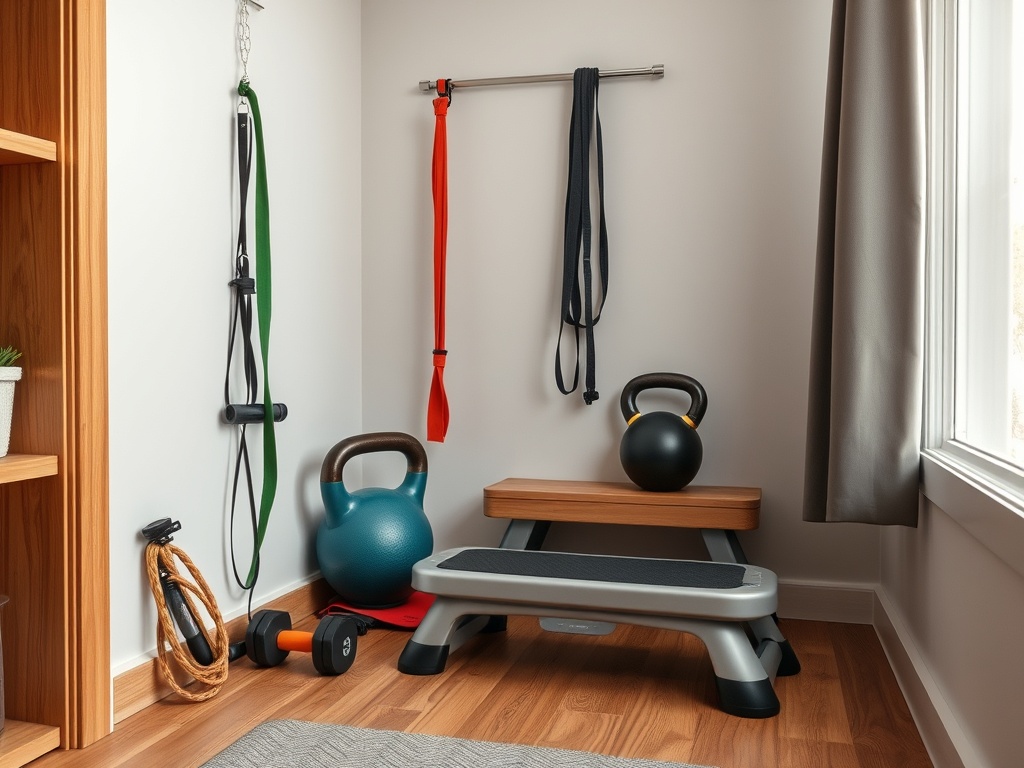
A complete setup can be surprisingly small: one low-impact option for steady work, one tool for short intervals, and enough resistance for basic strength. For many people, that could mean brisk outdoor walking plus a jump rope and adjustable dumbbell; for others, a stationary bike and bands are more realistic.
Choose the system that removes friction. If a tool makes it easy to start, easy to scale, and easy to repeat, it is doing its job. If it requires motivation just to set up, a simpler option may deliver better conditioning because you will actually use it.

Dr. Sophia Alvarez
<b>Location: </b>Chicago, Illinois Dr. Sophia Alvarez is a computational biologist and health tech researcher exploring the application of data science to personalized medicine and drug discovery. Based in Chicago, home to world-class medical and research institutions, Sophia holds a PhD in Computational Biology and has worked on projects ranging from genomics to clinical trial optimization. Her writing at Nano Write covers the intersection of healthcare, data, and technology, from AI in diagnostics to the business of healthtech startups. Sophia is passionate about making healthcare more precise and more accessible, and her articles reflect a deep understanding of both the science and the human dimensions of medicine. Outside of her research, Sophia advises healthtech startups and speaks at conferences on the future of healthcare.
More from Dr. Sophia